
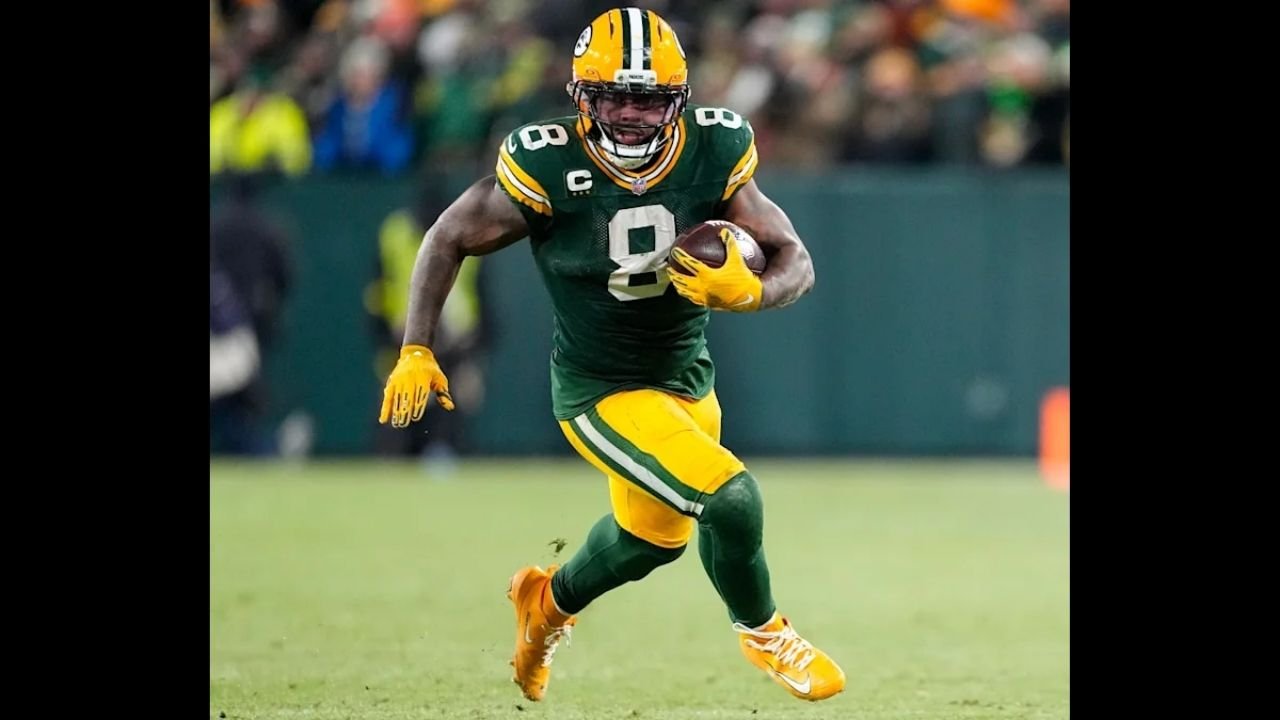
Green Bay Packers running back Josh Jacobs is facing two misdemeanor charges after investigators recovered surveillance footage that prosecutors say captured part of an alleged May 2026 confrontation at his Wisconsin home.
Jacobs, 28, was formally charged in Brown County on August 27 with misdemeanor battery and misdemeanor criminal damage to property. The charges followed a months-long investigation into an incident involving a woman identified in reports as his girlfriend.
The garage video has emerged as an important piece of evidence because authorities say it supports portions of the woman’s statement about what happened outside the residence.
The case has also affected Jacobs’ NFL career. Three days after the charges were announced, the league placed him on the Commissioner’s Exempt List, preventing him from practicing or playing while his status is reviewed.
Jacobs has not been convicted of either charge and is presumed innocent.
What Happened?
The investigation stems from an incident at Jacobs’ home near Green Bay on May 23, 2026.
Police responded after receiving a report about a disturbance involving Jacobs and his girlfriend.
According to the criminal complaint described by multiple news outlets, the woman told investigators that an argument developed after she looked through Jacobs’ phone and discovered communications with other women.
The disagreement allegedly escalated into a physical confrontation.
Responding officers documented physical signs that became part of the investigation, including redness and a reported bump on the woman’s head.
Garage Video
Investigators later obtained surveillance footage from the garage at Jacobs’ residence.
Recovering the relevant material reportedly took several weeks because accessing and processing the home’s surveillance system was complicated.
According to the criminal complaint, the recovered footage corroborated significant portions of the woman’s account concerning events inside the garage.
Authorities say the recording shows the woman attempting to leave through the garage.
Jacobs allegedly followed her and grabbed her as she tried to exit.
The complaint says he then threw her to the ground, causing her head to strike the floor.
She reportedly remained on the ground briefly before getting up.
Phone Allegation
The video also became relevant to the criminal damage charge.
According to prosecutors’ account of the footage, Jacobs took the woman’s phone while she was on the garage floor.
He allegedly walked away with the device before returning roughly 40 seconds later.
The complaint alleges that Jacobs damaged the phone.
Those portions of the recovered surveillance material contributed to prosecutors’ decision to file the two misdemeanor charges in August.
The actual surveillance recording has not been broadly released publicly as part of the reporting surrounding the charges.
Video Has Limits
There is an important limitation to what prosecutors say the surveillance evidence establishes.
The garage camera did not capture everything the woman initially alleged happened during the confrontation.
Authorities said the footage corroborated relevant portions of her description of what happened in the garage but did not record alleged events inside the residence.
That distinction became particularly significant when prosecutors decided which charges they believed were supported by available evidence.
Initial Arrest
Jacobs was initially arrested in May on suspicion of substantially more serious offenses.
He was booked on five counts, including a felony strangulation and suffocation allegation along with several misdemeanor allegations connected with domestic abuse.
However, prosecutors did not immediately move forward with those charges.
Jacobs was released while authorities continued investigating and attempting to obtain additional evidence.
The later recovery and forensic examination of the garage footage changed the evidentiary picture.
After reviewing the available material, Brown County District Attorney David L. Lasee’s office filed two Class A misdemeanor charges rather than the five allegations associated with Jacobs’ original booking.
Charges Reduced
The charges formally filed against Jacobs are misdemeanor battery and criminal damage to property.
Neither formal count includes a domestic-abuse designation.
The more serious felony strangulation allegation from the initial arrest was not included in the August criminal complaint.
Prosecutors have emphasized that filing charges does not establish guilt.
The district attorney’s office said the investigation was intended to provide a complete review of the available evidence and noted that some evidence became accessible only after substantial forensic work by law enforcement.
Jacobs retains the presumption of innocence as the case proceeds.
Lawyers Respond
Jacobs’ legal team has said the allegations should be resolved through the court process rather than through public debate.
Attorneys David Z. Chesnoff, Richard A. Schonfeld and Clarence F. Duchac III have represented the Packers running back.
Following the filing of the misdemeanor charges, his legal team highlighted the fact that prosecutors did not file domestic-violence charges.
Jacobs’ attorneys have indicated that they intend to address the accusations in court.
NFL Takes Action
The legal development quickly produced consequences for Jacobs’ football career.
On August 30, the NFL placed him on the Commissioner’s Exempt List.
Being placed on the list is an administrative measure rather than a finding that Jacobs committed the alleged offenses.
While he remains exempt, Jacobs cannot practice with the Packers or participate in games.
He can continue receiving his salary.
The NFL can conduct its own investigation under league policies independently of the criminal court process.
That means Jacobs’ eventual football discipline does not necessarily have to mirror the outcome of his criminal case.
Packers Add Running Back
Green Bay has already strengthened its running back room amid uncertainty surrounding Jacobs’ availability.
The Packers acquired Kaleb Johnson from the Pittsburgh Steelers in exchange for a 2028 sixth-round draft pick.
Johnson was selected by Pittsburgh in the third round of the 2025 NFL Draft after an impressive college career at Iowa.
His rookie season was limited, with 28 rushing attempts for 69 yards across 10 appearances.
A move to Green Bay could provide significantly more opportunity.
With Jacobs unavailable while on the exempt list, the Packers can turn to a group that includes Johnson, MarShawn Lloyd and Chris Brooks.
Jacobs’ Importance
Losing Jacobs is significant for Green Bay’s offense.
The former Alabama standout entered the NFL as a first-round selection of the Oakland Raiders in 2019 and developed into one of the league’s most productive running backs.
His best statistical season came in 2022, when he led the NFL with 1,653 rushing yards.
Jacobs joined Green Bay in 2024 on a four-year contract.
He has since remained a major part of the Packers’ rushing attack and recorded 929 rushing yards and 13 touchdowns during the 2025 season despite missing time with a knee injury.
What Happens Next?
Jacobs’ situation is now unfolding on two separate tracks.
The criminal case will determine whether prosecutors can prove the misdemeanor allegations beyond a reasonable doubt. Separately, the NFL will decide whether disciplinary action is appropriate under its policies.
The Commissioner’s Exempt List does not itself determine the outcome of either process.
The garage surveillance footage will remain particularly important because prosecutors say it provides independent visual evidence supporting portions of the account underlying the charges.
But the criminal complaint remains an accusation, not a conviction.
For the Packers, the immediate reality is simpler: they must prepare for the 2026 season without knowing when their starting running back will be permitted to return.
Until either the NFL changes Jacobs’ status or the legal proceedings provide greater clarity, the surveillance video, two misdemeanor charges and his absence from team activities will remain at the center of the Josh Jacobs case.